
How to Choose the Right Air Duct Cleaning Company in Baltimore
The right air duct cleaning company in Baltimore is one you can verify after the job, not just trust during it. Look for contractors who use truck-mounted negative pressure systems with documented CFM ratings, perform pre-job camera inspections, and leave you with three simple checks you can do yourself: register pull tests, visible boot inspections, and before-and-after airflow comparisons. If you’d rather not evaluate equipment specs yourself, call (855) 301-6549 — Robert Garcia handles every job personally and will walk you through exactly what to expect.
Here’s the problem most Baltimore homeowners face: you can’t watch your ducts being cleaned. The work happens inside walls, behind ceilings, in crawl spaces you don’t want to enter. That means every quality signal you can actually observe happens either before the truck arrives or after the crew leaves — and most people don’t know what to look for at either end. We’ve spent 14 years cleaning ducts in Federal Hill rowhouses, Roland Park colonials, and Canton condos, and we’ve seen what separates a proper job from a $99 coupon special that just stirred the dust around.
What a Properly Cleaned Duct System Actually Looks Like Afterward
Start with the outcome and work backward. A legitimate duct cleaning should leave your system measurably cleaner, not just feel cleaner. After the job, you should be able to verify three things yourself:
- Register pull test: Pop off a supply vent cover. The boot — the metal box behind the wall — should be visibly free of dust buildup, not just wiped at the opening. Run a white cloth along the interior surface; it should come back clean.
- Visible boot inspection: Shine a flashlight into the duct opening. You should see bare metal or clean fiberglass, not a fresh layer of disturbed debris coating the walls. If it looks like someone vacuumed the edges and called it done, that’s exactly what happened.
- Airflow comparison: Hold your hand in front of a register. Post-cleaning airflow should feel stronger and more consistent room-to-room, especially in upstairs bedrooms that were starved before. Restricted airflow often means the crew dislodged clogs but never extracted them properly.
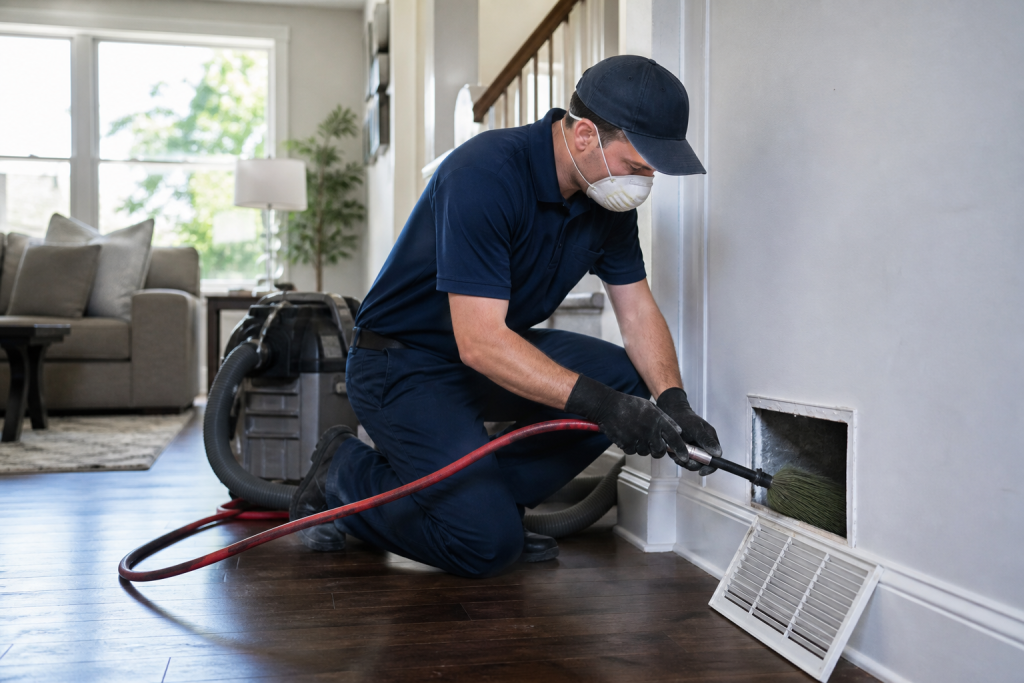
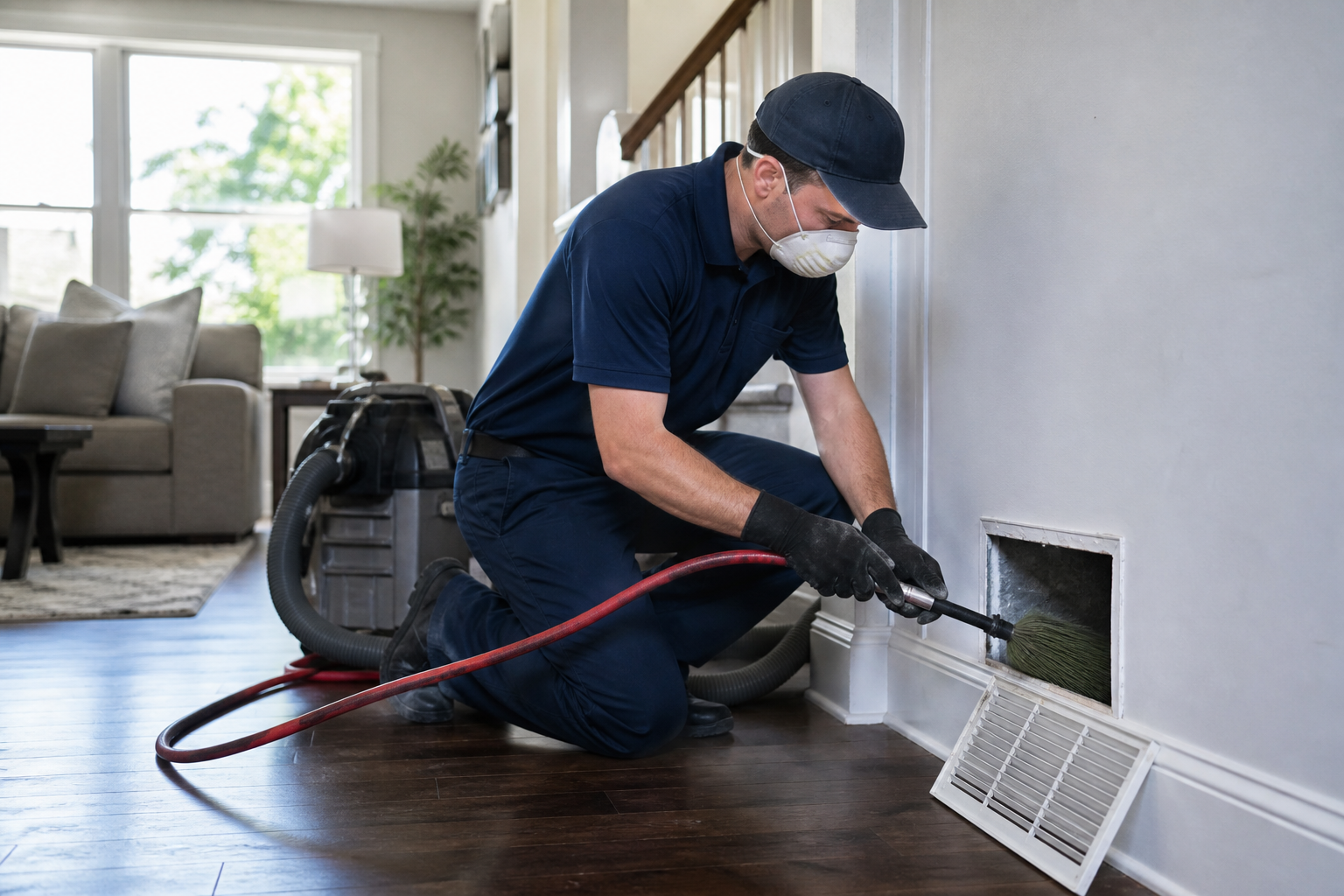
In our experience across Baltimore, the homes that fail these checks usually had one thing in common: a portable machine sitting in the hallway instead of a truck-mounted extraction system outside. A portable unit might generate 1,500–2,500 CFM. Our Rotobrush and Nikro truck-mounted systems pull 5,000+ CFM. That difference matters when you’re trying to extract heavy debris from a 40-foot duct run in a Hampden rowhouse.
The Equipment Question That Separates Legitimate Contractors from the Rest
Ask any contractor this before they quote: “Describe your negative pressure collection method and what CFM your equipment generates.” Legitimate technicians answer specifically. Deflection — “we use commercial-grade equipment” or “our system is very powerful” — is a red flag.
Here’s what you’re listening for:
- Truck-mounted power units that create true negative pressure throughout the system
- Specific CFM ratings (4,000+ for residential, with verification)
- Source-removal agitation tools — brushes, whips, or compressed air systems that knock debris loose so the vacuum can extract it
- Containment protocols, especially in older Baltimore homes with lead paint or asbestos concerns
We use Abatement Technologies containment equipment on jobs where cross-contamination is a risk — think post-renovation cleanups in Fells Point historic properties where plaster dust and old paint particulate can’t migrate to clean rooms. Generic contractors don’t carry this tier of equipment because it’s expensive to maintain and requires training most don’t invest in.
The other equipment tell: whether they bring a camera. A technician who inspects before quoting — actually scopes your ducts and shows you the condition — is demonstrating accountability. A technician who quotes over the phone without seeing your system is guessing, and the guess usually favors their bottom line, not your air quality.
How to Read Reviews for Technical Competence, Not Just Politeness
Google and BBB reviews are useful, but most Baltimore homeowners read them wrong. Five stars and “very nice guys” doesn’t mean your ducts got cleaned. Look for specific language patterns that indicate genuine technical work:
- Specific outcomes: “They showed me before-and-after photos from the camera,” or “The airflow in my son’s bedroom finally matches the master.”
- Equipment mentions: Reviews that name tools or methods — “truck-mounted vacuum,” “camera inspection,” “sealed off each room” — suggest the customer observed a process, not just a presence.
- Problem resolution: How a company handles complaints reveals more than perfect scores. Look for responses that address the technical issue specifically, not just apologies.
Our 254 reviews at a 4.7-star average include plenty of detailed feedback because Robert handles every job personally — customers interact with the owner, not a rotating crew. That accountability shows up in review specificity you won’t see from companies dispatching third-party labor.
One pattern to watch for: multiple reviews mentioning “quick” or “in and out in an hour” for a whole-house job. Proper duct cleaning takes time. A typical Baltimore rowhouse with basement-to-attic runs requires 3–5 hours. Speed is a warning sign.
Why Duct Cleaning Specialists Outperform HVAC Generalists
This is where most homeowners in Baltimore get steered wrong. Your HVAC contractor — the one who services your furnace — may offer duct cleaning as an add-on. That doesn’t mean they specialize in it.
HVAC generalists typically own portable equipment sufficient for light maintenance, not source removal. Their training centers on heating and cooling mechanics, not indoor air quality extraction protocols. We’ve been called to redo jobs in Mount Washington and Guilford where a generalist’s “duct cleaning” consisted of blowing compressed air through registers and collecting what fell out with a shop vac.
Specialist indicators to verify:
- Duct cleaning represents their primary service, not a seasonal upsell
- They own dedicated extraction equipment (Rotobrush, Nikro, or equivalent truck-mounted systems)
- They offer related air quality services — dryer vent cleaning, duct sealing, sanitizing — as core competencies, not referrals
- The technician performing the work has deep experience specifically in duct systems, not general HVAC installation
At Apex Air Duct Cleaning Maryland home, we’ve built our entire operation around indoor air quality. That scope — Air Duct Cleaning in Silver Spring, Dryer Vent Cleaning in Silver Spring, HVAC Cleaning in Silver Spring, plus duct repair, sealing, and air sanitizing — means we’re not borrowing equipment from another trade. We’re not referring your dryer vent job to a subcontractor. Robert handles it personally, with tools maintained specifically for this work.
Pre-Job Documentation: The Scope of Work Test
Before any work begins, you should receive a written scope detailing what’s included, what’s excluded, and how the job will be verified. Vague language — “clean all ducts” — invites corner-cutting. Specific language protects you:
- Number of supply and return registers to be serviced
- Whether the main trunk lines are included (many low bids exclude these)
- Access points that will be created and how they’ll be sealed afterward
- Verification method — camera inspection, airflow test, or both
- Cleanup and protection protocols for your floors, furniture, and belongings
We document every scope in writing because we’ve seen too many Baltimore homeowners discover, too late, that their “whole house” cleaning skipped the returns or never touched the dryer vent — a separate fire hazard that should be evaluated on every job. Speaking of which: if a duct cleaner doesn’t mention your dryer vent, they’re not thinking comprehensively about your air quality. In our 14 years, we’ve pulled lint accumulations from Park Heights to Patterson Park that were genuine ignition risks, not just efficiency drags.
When to Call a Pro — and What to Expect
If you’ve read this far and realized your last duct cleaning might not have been what you paid for, you’re not alone. The industry has a reputation problem because the barrier to entry is low — buy a portable machine, print flyers, undercut specialists by 60%.
Call a pro when:
- It’s been more than 3–5 years since your last cleaning, or you’ve never had one
- You’ve completed renovations — drywall dust is particularly destructive to HVAC components
- Allergy symptoms spike seasonally without clear outdoor triggers
- Your dryer requires multiple cycles, or you notice burning smells
- Visible mold appears near registers, or you smell mustiness when the system runs
When you call, expect to describe your home’s layout, age, and any specific concerns. Expect the technician to ask about your HVAC system type, not just schedule a time. And expect them to offer a camera inspection before quoting — because without seeing inside your ducts, any price is a guess.
Related services in Baltimore: If your system needs more than cleaning, explore our full indoor air quality scope — from duct sealing that stops conditioned air loss in drafty Baltimore basements, to Honeywell and Aprilaire air quality integrations for homes with persistent allergen issues.
The Bottom Line
Choosing the right duct cleaner in Baltimore comes down to verifiable specifics: equipment you can name, processes you can observe, and outcomes you can check yourself. The best contractors welcome post-job verification because their work holds up. They document scope in writing, answer technical questions directly, and carry tools that match the complexity of your system — not a portable unit that fits in a sedan trunk.
If you’re in Baltimore and want a technician who’ll show you the condition of your ducts before quoting, clean them with truck-mounted Rotobrush and Nikro extraction systems, and leave you with clear ways to verify the results, call (855) 301-6549 for a free estimate. Robert Garcia handles every job personally — 14 years, 254 reviews, and zero subcontracted crews.
Frequently Asked Questions
Whole-house duct cleaning in Baltimore typically ranges from $400 to $800 for a standard residential system, with larger homes or complex layouts running higher. Prices below $300 usually indicate limited scope — often just register vacuuming without trunk line cleaning or proper extraction equipment. Call (855) 301-6549 for an exact quote based on your home’s specific layout; estimates are free.
Every 3 to 5 years for most Baltimore homes, though older rowhouses with original ductwork, homes with pets, or properties near industrial zones in South Baltimore may need more frequent service. Our humid summers also promote microbial growth in poorly maintained systems. If you’re unsure of your last cleaning date, a camera inspection will tell you exactly where you stand.
Homeowners can vacuum register covers and wipe accessible boot openings, but proper source removal requires truck-mounted negative pressure equipment and mechanical agitation tools that aren’t available for consumer purchase. More importantly, disturbing debris without proper extraction can worsen indoor air quality temporarily. For anything beyond surface cleaning, professional service is the safer route.
Air duct cleaning addresses the distribution network — the supply and return ducts, registers, and boots that move air through your home. HVAC cleaning includes the mechanical components: the blower motor, evaporator coils, and heat exchanger inside the furnace or air handler. A complete indoor air quality service addresses both, since dirty components upstream recontaminate clean ducts immediately. We offer both as integrated services.
Perform the three checks we outlined: register pull test, visible boot inspection, and airflow comparison. If your boots still show dust accumulation, airflow hasn’t improved, or the job took less than two hours for a whole house, you likely received incomplete service. Many Baltimore homeowners don’t realize they’ve been shortchanged until they experience a proper cleaning for comparison.
Written by Robert Garcia, Owner & Lead Technician at Apex Air Duct Cleaning Maryland, serving Baltimore since 2012.
Need Air Duct Cleaning Help?
Call Apex Air Duct Cleaning Maryland — licensed & insured, here with fast after-hours help in Maryland.
(855) 301-6549